


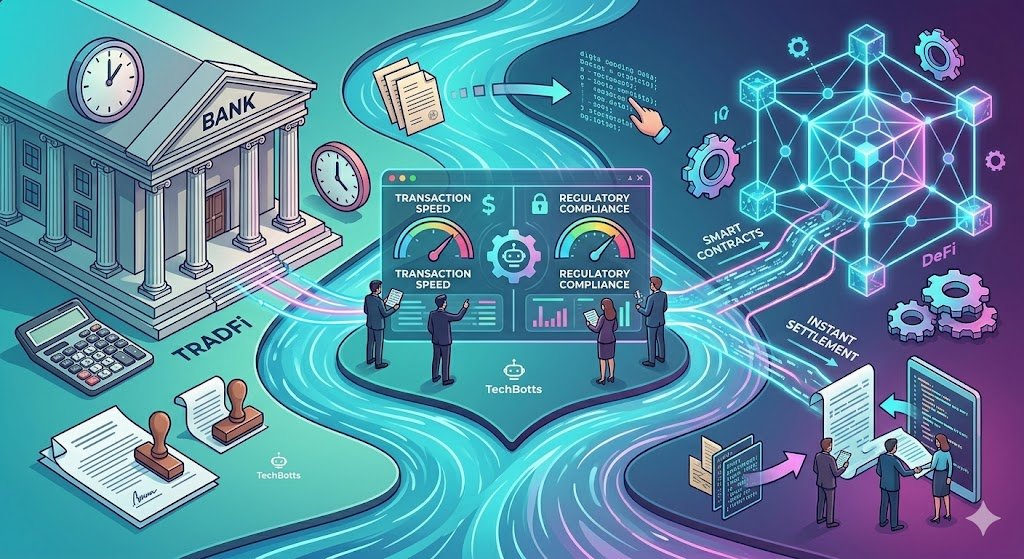
In 2026, the boardroom debate has shifted from “What is crypto?” to “How do we leverage Decentralized Finance (DeFi)?” While Traditional Finance (TradFi) offers the comfort of regulation and physical banks, DeFi is winning on speed and cost. Businesses are now using smart contracts to automate payroll, cross-border payments, and supply chain financing, reducing settlement times from days to seconds. For the modern enterprise, the goal isn’t to replace banks, but to use a hybrid model where blockchain handles the “plumbing” of global trade. Here is a detailed, ten-point look at how this battlefield is taking shape.
1. Transparency vs. Privacy
A fundamental clash exists between the two models regarding data. In TradFi, transactions are hidden behind proprietary institutional databases. Verification requires an opaque auditing process by third parties, often delaying financial reporting. DeFi, conversely, operates on public, immutable blockchains. The entire transaction history of an organization is globally visible and instantly verifiable. While this provides unparalleled transparency, it presents a challenge for corporate privacy, which is being managed through advanced cryptographic techniques like zero-knowledge proofs.
2. Trust Models: Code vs. Institutions
Traditional Finance is built entirely on institutional trust. A business trusts its bank to hold its funds, manage its payments, and adhere to regulatory frameworks. The entire system is backed by legal contracts and recourse to courts. DeFi replaces this with ‘trustless’ code. Businesses trust the mathematical certainty of smart contracts to execute transactions exactly as written, without the need for human intermediaries. The ‘code is law’ mantra provides efficiency but demands rigour in smart contract audits.
3. Cost Structures and Efficiency
A massive point of contention is overhead. TradFi cost structures are bloated by legacy systems, massive brick-and-mortar infrastructure, and a multitude of middlemen, each taking a fee. DeFi protocols are incredibly lean, often operated by small teams or decentralized autonomous organizations (DAOs). The primary costs in DeFi are network ‘gas’ fees, which, with the maturity of layer-2 scaling, have become negligible compared to traditional banking fees. For businesses running thousands of transactions daily, the efficiency gains from automating intermediaries are undeniable.
4. Cross-Border Settlement Speed
The TradFi model for global trade still relies on the archaic SWIFT messaging system, which acts as a ‘baton’ passed between multiple correspondent banks. A payment from New York to Tokyo can still take three to five business days to clear. DeFi is globally natively-digital. By bypassing these intermediaries, global settlements can be achieved in near-real-time—often under 30 seconds—regardless of geographical borders. For global supply chains, this near-instant settlement unlocks massive amounts of working capital that would otherwise be ‘trapped’ in transit.
5. Access and Programmability
TradFi is ‘permissioned.’ Access to capital markets and complex financial instruments is gated by financial institutions, requiring extensive KYC/AML checks and often, minimal capital thresholds. DeFi is ‘permissionless’ and open-source. Anyone—including autonomous corporate entities—can interact with DeFi protocols. Crucially, DeFi instruments are programmable. A corporation can write code to automatically rebalance its asset portfolio based on predefined market conditions, something that is incredibly slow and expensive to do in the manual world of TradFi.
6. Regulatory Frameworks and Legal Recourse
TradFi’s greatest advantage is its alignment with the established legal and regulatory order. The rules are clear, and in the case of a dispute or fraud, there is clear legal recourse. DeFi, by contrast, is a regulatory frontier. Regulators globally are still playing catch-up, leading to significant legal uncertainty for corporate DeFi integration. This uncertainty makes it difficult for traditional risk managers to sign off on full-scale DeFi adoption, especially regarding how DAO governance interacts with national corporate law.
7. Governance Models
Governance in TradFi is a centralized hierarchy. Decisions are made by a CEO, a board of directors, or a regulatory body. In DeFi, governance is decentralized and community-driven. Decision-making is handled through Governance Tokens, where holders vote on everything from fee structures to protocol upgrades. This participatory model offers businesses a voice in the infrastructure they use but requires them to actively manage a portfolio of tokens to ensure their governance power matches their infrastructure needs.
8. Systemic Risk: Centralized vs. Smart Contract Failure
The risks in TradFi are centralized and institutional. The failure of a systemically important bank can trigger a cascade of collapse, as seen in 2008. While this risk is managed through massive bailouts and regulation, it is an ever-present ‘hidden’ threat. The risks in DeFi are technical and code-based. The failure point is a bug in a smart contract. If a protocol’s code is compromised, assets can be lost instantly. Risk in DeFi is managed through mathematical audits,保险 (insurance) pools, and formalized, trustless disaster-recovery protocols, but it is a new type of risk that TradFi risk models are not equipped to measure.
9. Product Innovation Cycle
TradFi’s innovation cycle is incredibly slow, measured in years. The ‘product’ must pass through multiple layers of institutional approval and regulatory review before launch. In DeFi, innovation is collaborative, open-source, and iterates in days or weeks. Because the code is transparent, DeFi is ‘composable.’ Developers can ‘stack’ different financial legos to create entire new types of derivative products almost instantly. This rapid innovation cycle is why DeFi keeps outpacing TradFi, creating an ever-expanding library of tools for managing corporate liquidity and risk.
10. Custody and Control of Assets
A profound shift is occurring in how corporations think about asset custody. In TradFi, custody is ceded to a bank or third-party custodian. A business controls its money only by permission. In DeFi, a corporation practices ‘self-custody.’ It uses complex multi-signature wallets, where control is distributed among several executives or automated governance protocols. Self-custody offers total control but places total responsibility for security on the corporation itself. This requires a shift in internal security models, moving from managing passwords to managing cryptographic keys.
