


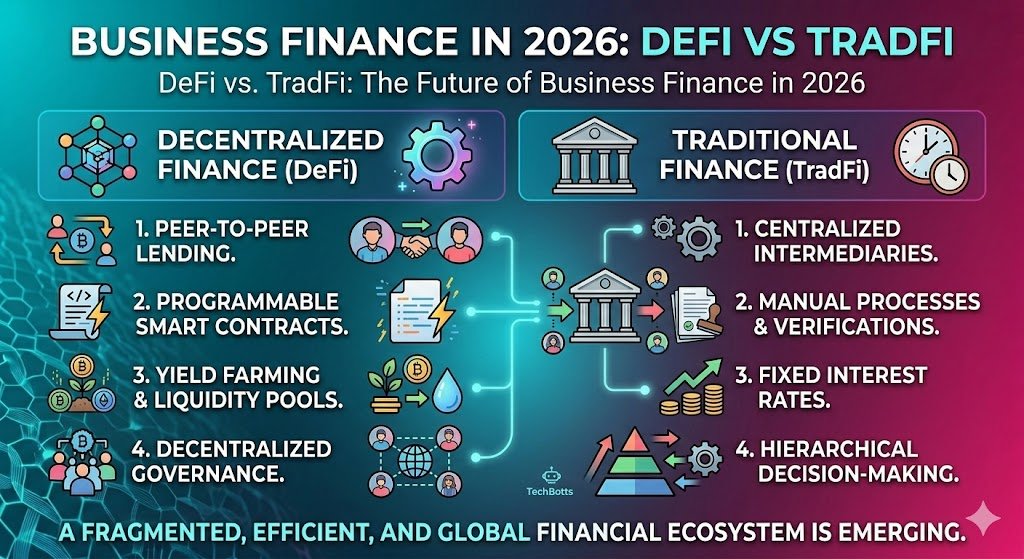
As we navigate the complexity of 2026, the global financial landscape is experiencing its most radical shift since the advent of online banking. A new model, Decentralized Finance (DeFi), is directly challenging the established order of Traditional Finance (TradFi), and for businesses, the choice between these two ecosystems is no longer hypothetical.
TradFi relies on central intermediaries—banks, stock exchanges, and regulatory bodies—to manage risk and verify transactions. It offers stability and legal recourse but can be slow, expensive, and limited by geographical boundaries. A cross-border corporate payment can still take days to settle.
In contrast, DeFi uses blockchain technology and smart contracts to automate these financial services. It is permissionless, 24/7, and settles in near-real-time. Businesses are now using DeFi platforms to access lending, manage asset liquidity, and execute global payments without intermediaries.
For TechBotts readers, the crucial consideration is efficiency. The choice between traditional security and decentralized speed is reshaping corporate treasury management. The future of business finance is an efficient, programmable, and global ecosystem.
